

When faced with uncertainty, it can be hard to see if the unknown will in fact change your decision. In hindsight, a particular decision might be good or bad, but we need a tool to help that understanding of the future guide the present.
Using a modified decision tree, we can assess how different cases of uncertainty might change our choice. Instead of using a regular decision tree, we modify it by adding an additional layer of decisions. Specifically, once we know how the uncertainty has unfolded, do we regret the choice we made?
Each leaf of the decision tree then captures the amount of regret we have, compared to if we had made a different decision.
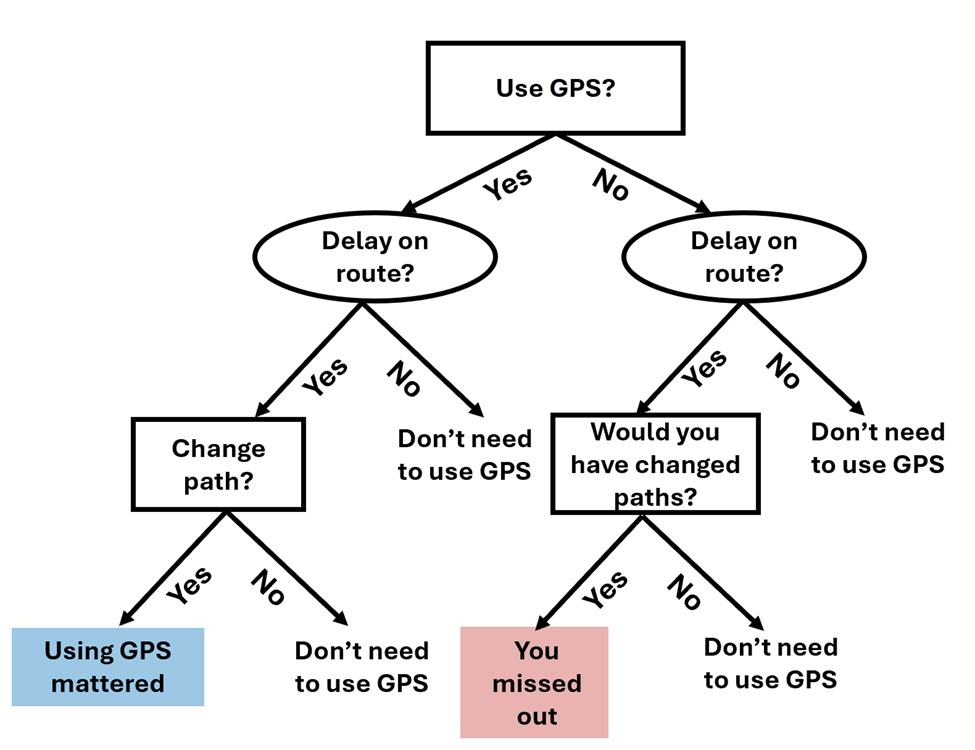
This simple tool allows the decision-maker to think about how different choices may lead to more or less regret in the future. In the figure above of deciding to use GPS or not, someone who is mildly annoyed by using GPS can assess how often they expect to wish they had used it.
This can help them to develop decision policies like “I prefer to use GPS if I will be driving on a major highway that is likely to have a long delay due to accidents.”